On Monday, one of the cover stories in the Express (a publication of the Washington Post) announced the alarming discovery of “six commonly used drugs” in the District of Columbia’s water supply. The discovery was the result of a study by the Associated Press, which found that pharmaceuticals were present in the water supplies of at least 41 million Americans. The drugs discovered in DC water included caffeine, naproxen, and ibuprofen. In many other cities across the nation other drugs, including sex hormones (from drugs like birth control and Viagra), were also found.
Reading this article made me very angry. Unlike the average express reader, I was not angered by the news that the water I drink could be harmful to my health; I had accepted that long ago. I was furious that what should already be common knowledge was presented as new, and that a public that should be better informed instead reacted with such surprise. I have known for years that our over-medicated species has been poisoning our waters, ourselves, and wildlife. I was disappointed that the AP article was narrowly focused on the effects these drugs could potentially have on human health, with only passing mentions of the well-documented ill effects drugs in small concentrations have on wildlife around the nation.
If you perused any of the articles covering this story, you will have read that when we take medications, ANY medications, the body does not metabolize the entire dose. What is left exits the body and enters the water cycle. Pharmaceuticals (as well as many other dangerous or toxic compounds such as flame retardants) enter the water system despite wastewater treatment, because current wastewater treatment practices do not remove them. A 2004 study by the U.S. Geological Survey (USGS) and the Centers for Disease Control and Prevention found that between 11 and 17 organic wastewater-related contaminants (OWCs) remained in wastewater after treatment.
It has been proven that these chemicals have drastic consequences for aquatic life. The September 2007 issue of Environmental Health News summarized a paper by Filby et. al. which studied the effects of one estrogen found in wastewater (17α- ethinylestradiol) on minnows. They found that exposure to wastewater containing estrogen caused “male fish to start producing egg yolk,” effected the blood concentration of hormones, and changed the expression of genes necessary for synthesizing hormones. The minnows also experiences a “decrease [in] the size of testes and alter[ation of] secondary sex characters, including coloration and behavior.”
A 2004 study by Nash et. al. studied the effects of estrogen on zebra fish by exposing them to environmentally relevant concentrations of estrogen. Fish which were exposed for only 40 days did not suffer significant effects, but lifelong exposure caused complete population failure with no fertilization, as the exposure caused the males to lack functional testes and instead have either undifferentiated or inter-sex gonads.
In the media coverage of the AP study, it was frequently mentioned that the effects of drugs at such low concentrations had not been studied in depth in humans, which as far as I can tell is a fair assessment. Still, if one drug can render a fish sterile in 2-5 years (the lifespan of a zebra fish), I cannot imagine what 30 or more years of exposure to a cocktail of drugs could do to people or other wildlife, despite the low concentrations. And, by the way, you can’t escape by drinking bottled water. Most bottling companies filter their water using the same technology as the wastewater plants, and that “pure” spring they draw from is likely already contaminated.
Now I try to keep my blog postings as hopeful as possible, but unfortunately as of yet there is no cost-effective or practical solution. The only successful methods of removing these compounds during wastewater treatment, such as reverse-osmosis, are prohibitively expensive to be performed on all the wastewater generated in the nation. Furthermore, our still rapidly growing world population depends greatly on pharmaceutical birth control, which is more effective than other methods. In order to develop a solution, more research is necessary into improved wastewater treatment technology, and into better drugs that are more efficiently metabolized by the body or have fewer consequences outside it. And of course, little difference though it will make, I know I am going to be thinking a lot more carefully about whether or not I actually need that 4 pm Tylenol.
Another interesting study on the effects of chemicals on frogs can be found here.
And a side note: The antibiotics that end up in our wastewater (whether the penicillin you took for your last infection or the Clorox you used to whiten your towels) contribute to the evolution of drug-resistant strains of bacteria and viruses. While somewhat unlikely, it is possible that our over-zealous need to be “clean” could create a resistant and deadly strain of germ.
Wednesday, March 12, 2008

Monday, March 10, 2008
TAMPONS
This past Saturday, March 8, was International Women's Day. I asked my boyfriend, "What are you doing for me today?" He studied abroad in Cuba, which, like all communist countries, actually celebrates the holiday. Apparently, it didn't make a big impression on him, though. "Treating you well, just like I do every day" he replied. "Aw, that's sweet," I said, "but in Poland they give the women flowers."*
Clearly, I had to find another way to celebrate. So I put on my comfiest pj's, curled up in bed and read a large portion of Our Bodies Ourselves. One section discussed menstrual products ("sanitary napkins"), and touched very briefly upon their environmental impact, which is huge.
Yes, ladies and gentlemen, this is a post about menstruation. PERIODS! TAMPONS! PADS! BLOOD! VAGINA! Ok, I think I've gotten it all out of the way. Hopefully, some of you are still with me, especially the ladies, since this is an International Women's Day special just for us (fellas can read if they want.... if they all haven't abandoned ship by now). I know this is a topic that's considered taboo or at least impolite, embarrassing, or awkward--but it's precisely because people find it hard to talk about that menstrual product activism hasn't taken off. It's because it's not a "sexy" cause that the fairly easily relieved environmental impact is still so great. So let's talk about it.
If you use 20 pads or tampons per period, and have your period once a month from age 12 to 47, that's 8,400 pads and tampons in your lifetime. There are three billion of us (women) on earth, and about 150 million of us in the United States... that's a lot of pads and tampons. Unfortunately, many tampons are flushed down the toilet, which means that tampons (and applicators) often litter the water of our beaches. Many tampon applicators are plastic, which means they don't biodegrade (mainstream tampons biodegrade in six months). Mainstream pads also come wrapped in plastic, and are lined along the bottom in plastic, which means they have a permanent place of honor in our landfills. In addition, those pads and tampons had to come from somewhere- cotton farms that could be left as forests or used to grow corn for biofuel or any number of other products, lessening the burden on the land.
Furthermore, we have the issue of dioxins. The wood pulp used to make mainstream tampons and pads is bleached early in the process. There is no reason for this use of chlorine, which then pollutes the earth, except to make the tampons and pads seem "clean" and "fresh"- the irony is delicious, no? The bleaching process leaves behind dioxins as a byproduct- dioxins are considered by the FDA to be likely cancer-causing agents. The bleach-dioxins add to the dioxins already in the cotton from pesticide use during growth. Our vaginae (Blogger is telling me the Latin plural is correct for vagina) are more sensitive and absorbent than most other parts of our bodies. Why expose them to poisons when we don't have to- why take risks we can easily avoid?
Oh, and did I mention pads increase the risk of yeast infections?
Now, before I talk about solutions, I feel I should 'fess up to something: I am a part of the problem. Yes, I am a mainstreamer, a Tampax and Always woman. I'm helping fill the landfills and possibly poisoning my body in the process. But, after researching these solutions, I am resolved to try at least one of them. Who knows, perhaps in a couple months I'll be able to write an entry about how each possible "solution" to the menstrual product environmental problem feels and functions. I'm all for saving the environment, but I also like wearing bathing suits and playing soccer.
Before I get into each possible solution, here's the link to the Our Bodies Ourselves page about these products. One other note: props to my housemate Emily for having tried many of these products and telling me all about them.
1. The solution that requires the least change but also creates the least change (but a lot better than no change!) is using organic 100% cotton tampons and pads. This gets rid of the chlorine/dioxin problem, and the plastic applicators, wrap, and lining. It doesn't reduce our use of cotton, but it minimizes the environmental effects post-use, because they're 100% biodegradable. Emily says they work well and she's never had a problem with leakage (which I thought might be a concern because there's no plastic lining on the bottom). The pads are a little thicker than mainstream pads, and the cotton can start to separate a little if you've been wearing it for a while or moving around a lot. The tampons are a little drier than mainstream ones. But hey, they're less likely to give you cancer! I saw an Amazon.com listing for a 12 pack of 20-tampon boxes (that's 240 tampons) for about $50. That's a good deal, and let's be honest- we've got pretty good biological evidence that we'll use them all eventually. I'll probably choose to buy some organic cotton tampons and pads, just as a back up in case the other "solutions" I try don't work out in all situations. The devil you know, right?
2. Reusable pads. An example of this is GladRags. They're made out of cloth (you can even make them yourself from old clothing!) and consist of an outer layer that's shaped vaguely like a mainstream, winged pad. the "wings" snap together under your underwear, holding the pad in place, and there's a slot into which you can insert little cloth fillers (about the size and shape of panty-liners). You can put a different number of fillers in (or none) depending on how heavy your flow is that day. There is a bigger reusable pad for overnight. When you want to change it, you just wash out the main pad and the fillers. Apparently they're really comfortable, although they are thick, because they wrap all the way around to snap underneath. Bonus for gardeners and people who don't share bathrooms with others who might get freaked out: if you soak the pad in water in a jar or something before washing it, you can use the menstruation-water to fertilize your garden. It looks like the day pads are around $10-15 each, and the overnight pads are $15-20. You can also make some for yourself for FREE (my favorite word!), if you're up for an environmental craft project. They last for five years, at least. Reusable pads sound really cool to me, especially since you can make them out of recycled materials, but... I do my laundry as rarely as possibly, so I don't know if this is a good choice for me.
3. Cups. Check out keeper.com for more details (and nifty visuals)- Keeper is the most common brand of menstrual cup. It a gum-rubber or silicone (for those allergic to latex) cup with a little stem coming out the bottom. You fold the cup twice, insert it in your vagina, then pull gently down on the stem. It suctions in place and you can even use it while you're swimming. The cup holds about an ounce of fluid- and most women only menstruate four or five ounces. The website says you might end up changing it twice a day (just pull it out--upright--then tip it over into the toilet), but I'd probably empty it each time I was in the bathroom. You can wash it with soap and water, and between periods you can store it in a little cloth bag they give to you. I have no idea how this feels, but the website mentioned that some women choose to cut off up to half of the "stem" for comfort. The Keeper costs $35, lasts for ten years, and is available on their site or in Whole Foods and other stores. I think this is the one I'm going to try first.
4. The Sea Pearl. This is a reusable tampon made out of a sea sponge. Unfortunately, our seas are even more polluted than our land, and that pollution can become concentrated in organisms like sea sponges. Our Bodies Ourselves said that because of this, many women who us the Sea Pearl choose to boil it in water for ten minutes before first use. Elle Bee (EO's resident environmental scientist), please tell me- does that actually work? Does boiling things remove pollutants? Apparently the boiling makes it slightly smaller and less flexible each time you do it. You can clean them by boiling them, soaking them in vinegar, or some other options. They last about six months, and cost about $5 each from GladRags. I don't know anyone who's personally tried sea sponge tampons. I probably won't try it, because of the pollution thing.
That's all I've got. Remember to check out the Our Bodies Ourselves page for more info on these products, as well as others I didn't mention because I'm getting tired. I hope you had a happy International Women's Day!
*Please note: my boyfriend is awesome and this story about him is merely for comedic effect.
Clearly, I had to find another way to celebrate. So I put on my comfiest pj's, curled up in bed and read a large portion of Our Bodies Ourselves. One section discussed menstrual products ("sanitary napkins"), and touched very briefly upon their environmental impact, which is huge.
Yes, ladies and gentlemen, this is a post about menstruation. PERIODS! TAMPONS! PADS! BLOOD! VAGINA! Ok, I think I've gotten it all out of the way. Hopefully, some of you are still with me, especially the ladies, since this is an International Women's Day special just for us (fellas can read if they want.... if they all haven't abandoned ship by now). I know this is a topic that's considered taboo or at least impolite, embarrassing, or awkward--but it's precisely because people find it hard to talk about that menstrual product activism hasn't taken off. It's because it's not a "sexy" cause that the fairly easily relieved environmental impact is still so great. So let's talk about it.
If you use 20 pads or tampons per period, and have your period once a month from age 12 to 47, that's 8,400 pads and tampons in your lifetime. There are three billion of us (women) on earth, and about 150 million of us in the United States... that's a lot of pads and tampons. Unfortunately, many tampons are flushed down the toilet, which means that tampons (and applicators) often litter the water of our beaches. Many tampon applicators are plastic, which means they don't biodegrade (mainstream tampons biodegrade in six months). Mainstream pads also come wrapped in plastic, and are lined along the bottom in plastic, which means they have a permanent place of honor in our landfills. In addition, those pads and tampons had to come from somewhere- cotton farms that could be left as forests or used to grow corn for biofuel or any number of other products, lessening the burden on the land.
Furthermore, we have the issue of dioxins. The wood pulp used to make mainstream tampons and pads is bleached early in the process. There is no reason for this use of chlorine, which then pollutes the earth, except to make the tampons and pads seem "clean" and "fresh"- the irony is delicious, no? The bleaching process leaves behind dioxins as a byproduct- dioxins are considered by the FDA to be likely cancer-causing agents. The bleach-dioxins add to the dioxins already in the cotton from pesticide use during growth. Our vaginae (Blogger is telling me the Latin plural is correct for vagina) are more sensitive and absorbent than most other parts of our bodies. Why expose them to poisons when we don't have to- why take risks we can easily avoid?
Oh, and did I mention pads increase the risk of yeast infections?
Now, before I talk about solutions, I feel I should 'fess up to something: I am a part of the problem. Yes, I am a mainstreamer, a Tampax and Always woman. I'm helping fill the landfills and possibly poisoning my body in the process. But, after researching these solutions, I am resolved to try at least one of them. Who knows, perhaps in a couple months I'll be able to write an entry about how each possible "solution" to the menstrual product environmental problem feels and functions. I'm all for saving the environment, but I also like wearing bathing suits and playing soccer.
Before I get into each possible solution, here's the link to the Our Bodies Ourselves page about these products. One other note: props to my housemate Emily for having tried many of these products and telling me all about them.
1. The solution that requires the least change but also creates the least change (but a lot better than no change!) is using organic 100% cotton tampons and pads. This gets rid of the chlorine/dioxin problem, and the plastic applicators, wrap, and lining. It doesn't reduce our use of cotton, but it minimizes the environmental effects post-use, because they're 100% biodegradable. Emily says they work well and she's never had a problem with leakage (which I thought might be a concern because there's no plastic lining on the bottom). The pads are a little thicker than mainstream pads, and the cotton can start to separate a little if you've been wearing it for a while or moving around a lot. The tampons are a little drier than mainstream ones. But hey, they're less likely to give you cancer! I saw an Amazon.com listing for a 12 pack of 20-tampon boxes (that's 240 tampons) for about $50. That's a good deal, and let's be honest- we've got pretty good biological evidence that we'll use them all eventually. I'll probably choose to buy some organic cotton tampons and pads, just as a back up in case the other "solutions" I try don't work out in all situations. The devil you know, right?
2. Reusable pads. An example of this is GladRags. They're made out of cloth (you can even make them yourself from old clothing!) and consist of an outer layer that's shaped vaguely like a mainstream, winged pad. the "wings" snap together under your underwear, holding the pad in place, and there's a slot into which you can insert little cloth fillers (about the size and shape of panty-liners). You can put a different number of fillers in (or none) depending on how heavy your flow is that day. There is a bigger reusable pad for overnight. When you want to change it, you just wash out the main pad and the fillers. Apparently they're really comfortable, although they are thick, because they wrap all the way around to snap underneath. Bonus for gardeners and people who don't share bathrooms with others who might get freaked out: if you soak the pad in water in a jar or something before washing it, you can use the menstruation-water to fertilize your garden. It looks like the day pads are around $10-15 each, and the overnight pads are $15-20. You can also make some for yourself for FREE (my favorite word!), if you're up for an environmental craft project. They last for five years, at least. Reusable pads sound really cool to me, especially since you can make them out of recycled materials, but... I do my laundry as rarely as possibly, so I don't know if this is a good choice for me.
3. Cups. Check out keeper.com for more details (and nifty visuals)- Keeper is the most common brand of menstrual cup. It a gum-rubber or silicone (for those allergic to latex) cup with a little stem coming out the bottom. You fold the cup twice, insert it in your vagina, then pull gently down on the stem. It suctions in place and you can even use it while you're swimming. The cup holds about an ounce of fluid- and most women only menstruate four or five ounces. The website says you might end up changing it twice a day (just pull it out--upright--then tip it over into the toilet), but I'd probably empty it each time I was in the bathroom. You can wash it with soap and water, and between periods you can store it in a little cloth bag they give to you. I have no idea how this feels, but the website mentioned that some women choose to cut off up to half of the "stem" for comfort. The Keeper costs $35, lasts for ten years, and is available on their site or in Whole Foods and other stores. I think this is the one I'm going to try first.
4. The Sea Pearl. This is a reusable tampon made out of a sea sponge. Unfortunately, our seas are even more polluted than our land, and that pollution can become concentrated in organisms like sea sponges. Our Bodies Ourselves said that because of this, many women who us the Sea Pearl choose to boil it in water for ten minutes before first use. Elle Bee (EO's resident environmental scientist), please tell me- does that actually work? Does boiling things remove pollutants? Apparently the boiling makes it slightly smaller and less flexible each time you do it. You can clean them by boiling them, soaking them in vinegar, or some other options. They last about six months, and cost about $5 each from GladRags. I don't know anyone who's personally tried sea sponge tampons. I probably won't try it, because of the pollution thing.
That's all I've got. Remember to check out the Our Bodies Ourselves page for more info on these products, as well as others I didn't mention because I'm getting tired. I hope you had a happy International Women's Day!
*Please note: my boyfriend is awesome and this story about him is merely for comedic effect.
Wednesday, March 5, 2008
Environmentally Friendly Paving
Green building is finally gaining momentum, especially in DC! They are retro-fitting existing buildings with green technology and even going for LEED certification in new buildings. (Of course, I haven’t seen any advertisements for green features in the hundreds of new, over-priced luxury condos around DC, but it’s a start!)
While meditating on two projects close to my heart, the new School of International Service building at American University, and the new Nationals Baseball Park, I began to wonder why green building is making such advances, while green pavement still has not caught on.
Pavement, asphalt, black top, concrete: all are bad news for our planet. Surfaces paved with traditional asphalt and concrete are impermeable to water. Any rain that falls onto this kind of pavement does not percolate down into the ground, but rather runs over the pavement and into down storm drains. On the way it picks up litter, pesticides, and toxic heavy metals from the tires that run over it all day. All of this bad stuff ends up in our waterways, and even drinking water. In case you thought otherwise, stormwater that runs through a “modern,” separated municipal system is not treated before it enters our lakes and streams. Stormwater coming from a system that operates combined sewer overflows is treated, but during a high-volume even can be even worse for the environment and human health, as it releases raw sewage into our streams and waterways with the stormwater.* EPA calculates that in the United States, stormwater runoff from residential, commercial, and industrial areas is responsible for 21% of impaired lakes and 45% of impaired estuaries. In the Mid-Atlantic region alone, stormwater is responsible for over 4,000 miles of impaired streams.
Not only does stormwater pollute ponds and creeks (and eventually major rivers and the oceans), but it also disturbs the local water cycle. When the water runs directly from the pavement to streams, local flora and fauna are deprived of this vital resource. Furthermore, areas with many acres under pavement, such as cities, can greatly affect the water table beneath them, depriving humans of necessary water.
What, you may ask, is the solution? On the market right now are pavements that allow water to pass through them. In fact, porous pavement has been around since the 1970’s, although it still isn’t widely used. This kind of pavement solves many of the problems caused by traditional pavement. Litter remains on the street to be picked up, instead of in streams where it can hurt wildlife. The water percolates naturally through the soil, which filters out most of the heavy metals, chemicals, and bacteria. Porous pavement helps prevent environmental degradation by acid rain, because the soil is a natural buffer, and neutralizes almost all of the acid. Water naturally enters the water table, giving plants, animals, and even humans more reliable access to water. And, best part of all, no puddles!
Porous concretes and asphalts look almost identical to their impermeable counterparts, and are cheaper to install for most construction projects. This is because although the porous material itself is slightly more expensive, it does not require the costly drain and sewer infrastructure of traditional pavement. Many studies have also found that the porous pavement wears better than traditional pavements, and needs to be replaced less often.
So, with all this new information in mind, why haven’t porous pavements caught on? I suspect it is because of ignorance of stormwater problems and their solution. You can do your part by being an advocate of porous pavements in your community. For more information, visit http://www.stormcon.com/sw_0305_porous.html.
* More than 27 billion gallons of raw sewage and polluted stormwater discharge out of 460 combined sewage overflows (“CSOs”) into New York Harbor each year. Scary? That’s just New York . . . CSOs are a major problem for water quality. While it may seem unbelievable that in this day and age raw sewage is still discharged into rivers, about 40 million people live in cities with combined sewer systems, and CSOs are a major water pollution concern for 772 cities. CSOs annually result in an estimated 850 billion gallons of untreated wastewater and stormwater being discharged into U.S. waterways. (See the EPA’s CSO report here.) According to the DC Water and Sewer Authority, 2,489 million gallons of raw sewage and stormwater are discharged annually from the District of Columbia. (More about DC WASA and combined sewer overflow here.)
While meditating on two projects close to my heart, the new School of International Service building at American University, and the new Nationals Baseball Park, I began to wonder why green building is making such advances, while green pavement still has not caught on.
Pavement, asphalt, black top, concrete: all are bad news for our planet. Surfaces paved with traditional asphalt and concrete are impermeable to water. Any rain that falls onto this kind of pavement does not percolate down into the ground, but rather runs over the pavement and into down storm drains. On the way it picks up litter, pesticides, and toxic heavy metals from the tires that run over it all day. All of this bad stuff ends up in our waterways, and even drinking water. In case you thought otherwise, stormwater that runs through a “modern,” separated municipal system is not treated before it enters our lakes and streams. Stormwater coming from a system that operates combined sewer overflows is treated, but during a high-volume even can be even worse for the environment and human health, as it releases raw sewage into our streams and waterways with the stormwater.* EPA calculates that in the United States, stormwater runoff from residential, commercial, and industrial areas is responsible for 21% of impaired lakes and 45% of impaired estuaries. In the Mid-Atlantic region alone, stormwater is responsible for over 4,000 miles of impaired streams.
Not only does stormwater pollute ponds and creeks (and eventually major rivers and the oceans), but it also disturbs the local water cycle. When the water runs directly from the pavement to streams, local flora and fauna are deprived of this vital resource. Furthermore, areas with many acres under pavement, such as cities, can greatly affect the water table beneath them, depriving humans of necessary water.
What, you may ask, is the solution? On the market right now are pavements that allow water to pass through them. In fact, porous pavement has been around since the 1970’s, although it still isn’t widely used. This kind of pavement solves many of the problems caused by traditional pavement. Litter remains on the street to be picked up, instead of in streams where it can hurt wildlife. The water percolates naturally through the soil, which filters out most of the heavy metals, chemicals, and bacteria. Porous pavement helps prevent environmental degradation by acid rain, because the soil is a natural buffer, and neutralizes almost all of the acid. Water naturally enters the water table, giving plants, animals, and even humans more reliable access to water. And, best part of all, no puddles!
Porous concretes and asphalts look almost identical to their impermeable counterparts, and are cheaper to install for most construction projects. This is because although the porous material itself is slightly more expensive, it does not require the costly drain and sewer infrastructure of traditional pavement. Many studies have also found that the porous pavement wears better than traditional pavements, and needs to be replaced less often.
So, with all this new information in mind, why haven’t porous pavements caught on? I suspect it is because of ignorance of stormwater problems and their solution. You can do your part by being an advocate of porous pavements in your community. For more information, visit http://www.stormcon.com/sw_0305_porous.html.
* More than 27 billion gallons of raw sewage and polluted stormwater discharge out of 460 combined sewage overflows (“CSOs”) into New York Harbor each year. Scary? That’s just New York . . . CSOs are a major problem for water quality. While it may seem unbelievable that in this day and age raw sewage is still discharged into rivers, about 40 million people live in cities with combined sewer systems, and CSOs are a major water pollution concern for 772 cities. CSOs annually result in an estimated 850 billion gallons of untreated wastewater and stormwater being discharged into U.S. waterways. (See the EPA’s CSO report here.) According to the DC Water and Sewer Authority, 2,489 million gallons of raw sewage and stormwater are discharged annually from the District of Columbia. (More about DC WASA and combined sewer overflow here.)
Tuesday, February 19, 2008
Environmental Outrage: Office Composting
My journey with indoor composting began when I read and fell in LOVE with Cradle to Cradle by McDonough & Braungart. I offer up as one of my core personal beliefs that Cradle to Cradle should be #1 on a list of required reading for the whole human race.*
In brief, McDonough & Braungart theorize that the earth functioned without environmental problems for eons because before the arrival of modern man there was no such thing as waste. The whole planet was a biological system in which one organism’s waste, such as the fallen petals of a cherry tree, became food for other organisms. (The petals degrade naturally and return the nutrients to the soil.) When modern man came on the scene, “waste” was created. Waste includes both natural things disposed of in such a way that the nutrients do not properly re-enter the system (ex. paper waste or food going to landfills), as well as items that are artificial and cannot ever re-enter the biological system (ex. plastics or items made with toxic heavy metals). If humanity could re-evaluate their use of resources so that our own “waste” can be returned to the biological system, or become fuel for other processes, then many of our major environmental problems could be solved.
McDonough and Braungart have a green design firm and try their absolute best to practice what they preach. In the firm’s summer 2007 newsletter, they informed the world that their studio in Charlottesville was adopting indoor vermiculture, or composting using worms. They keep their composter in a closet, where one pound of worms consume about ½ pound of food scraps and office paper daily! As the worm colony matures, more worms will be born, and their ability to consume waste will increase. Answering what I would consider the most important question, they say there is no smell associated with the composter, and other than making sure the worms get fed with our “trash” these helpful pets do not require any attention. The food and paper scraps are turned into rich, nutrient-laden soil which can be brought home by the employees for gardening. Let me just say: I think this is the most AWESOME, EASY, and UNIQUE way to green an office I have ever heard of! One of my new personal goals is to spread the word about indoor composting, and to get as many places as I can to adopt this practice.
I began first by recommending indoor composting (vermiculture) to a small business opening up in Connecticut. They were not impressed. In theory, they thought it was a good idea, but did not want to spend the time ordering bins and worms, especially because they expected to move to a new space in a few months. And of course there was the weird factor. I am still hopeful that they will adopt in-office composting once they are settled in their new space, and plan to follow up with them after the move.
A few weeks later composting came up in conversation at my office (an environmental non-profit that shall remain nameless). I was so excited! I thought this was the perfect opportunity! And yet … ENVIRONMENTAL OUTRAGE! Despite the fact that indoor composting has been around for over 15 years, and that I recommended an affordable unit for indoor composting without worms, I was told that indoor composting would “attract vermin.” Used correctly, the proper indoor or outdoor composting unit will not! Disposing of food in a sealed, airtight box is definitely less susceptible to vermin than throwing it out in our communal office kitchen, where it will sit in an open trash can until someone deigns to take out the trash! I cannot put into words the frustration that this has caused me! Here, working for an organization whose mission is to protect the environment, in an office that is trying to be “greener,” indoor composting has been vetoed by someone who knows nothing about it! (And apparently did not even read the proposal, which discussed all these issues!) Of course, this is just one example a larger problem. Our society is ignorant and/or uncomfortable when it comes to the creative and extremely effective ways scientists and everyday people have devised to decrease the impact we all have on the planet.
I will not yield in my quest to get the word out about the possibilities for and advantages of indoor composting, in both offices and houses. If you would like to learn how to begin, please check out the following websites:
http://lancaster.unl.edu/pest/resources/vermicompost107.shtml;
http://www.composters.com/; http://www.thewormfarm.net/; http://www.wormwoman.com/
*William Kennedy from the New York Times said, "One Hundred Years of Solitude is the first piece of literature since the Book of Genesis that should be required reading for the entire human race.” While both Genesis and Solitude are significant, I stand by my belief that everyone on the planet should read Cradle to Cradle first and foremost, and possibly Bill McKibben’s Maybe One second.
In brief, McDonough & Braungart theorize that the earth functioned without environmental problems for eons because before the arrival of modern man there was no such thing as waste. The whole planet was a biological system in which one organism’s waste, such as the fallen petals of a cherry tree, became food for other organisms. (The petals degrade naturally and return the nutrients to the soil.) When modern man came on the scene, “waste” was created. Waste includes both natural things disposed of in such a way that the nutrients do not properly re-enter the system (ex. paper waste or food going to landfills), as well as items that are artificial and cannot ever re-enter the biological system (ex. plastics or items made with toxic heavy metals). If humanity could re-evaluate their use of resources so that our own “waste” can be returned to the biological system, or become fuel for other processes, then many of our major environmental problems could be solved.
McDonough and Braungart have a green design firm and try their absolute best to practice what they preach. In the firm’s summer 2007 newsletter, they informed the world that their studio in Charlottesville was adopting indoor vermiculture, or composting using worms. They keep their composter in a closet, where one pound of worms consume about ½ pound of food scraps and office paper daily! As the worm colony matures, more worms will be born, and their ability to consume waste will increase. Answering what I would consider the most important question, they say there is no smell associated with the composter, and other than making sure the worms get fed with our “trash” these helpful pets do not require any attention. The food and paper scraps are turned into rich, nutrient-laden soil which can be brought home by the employees for gardening. Let me just say: I think this is the most AWESOME, EASY, and UNIQUE way to green an office I have ever heard of! One of my new personal goals is to spread the word about indoor composting, and to get as many places as I can to adopt this practice.
I began first by recommending indoor composting (vermiculture) to a small business opening up in Connecticut. They were not impressed. In theory, they thought it was a good idea, but did not want to spend the time ordering bins and worms, especially because they expected to move to a new space in a few months. And of course there was the weird factor. I am still hopeful that they will adopt in-office composting once they are settled in their new space, and plan to follow up with them after the move.
A few weeks later composting came up in conversation at my office (an environmental non-profit that shall remain nameless). I was so excited! I thought this was the perfect opportunity! And yet … ENVIRONMENTAL OUTRAGE! Despite the fact that indoor composting has been around for over 15 years, and that I recommended an affordable unit for indoor composting without worms, I was told that indoor composting would “attract vermin.” Used correctly, the proper indoor or outdoor composting unit will not! Disposing of food in a sealed, airtight box is definitely less susceptible to vermin than throwing it out in our communal office kitchen, where it will sit in an open trash can until someone deigns to take out the trash! I cannot put into words the frustration that this has caused me! Here, working for an organization whose mission is to protect the environment, in an office that is trying to be “greener,” indoor composting has been vetoed by someone who knows nothing about it! (And apparently did not even read the proposal, which discussed all these issues!) Of course, this is just one example a larger problem. Our society is ignorant and/or uncomfortable when it comes to the creative and extremely effective ways scientists and everyday people have devised to decrease the impact we all have on the planet.
I will not yield in my quest to get the word out about the possibilities for and advantages of indoor composting, in both offices and houses. If you would like to learn how to begin, please check out the following websites:
http://lancaster.unl.edu/pest/resources/vermicompost107.shtml;
http://www.composters.com/; http://www.thewormfarm.net/; http://www.wormwoman.com/
*William Kennedy from the New York Times said, "One Hundred Years of Solitude is the first piece of literature since the Book of Genesis that should be required reading for the entire human race.” While both Genesis and Solitude are significant, I stand by my belief that everyone on the planet should read Cradle to Cradle first and foremost, and possibly Bill McKibben’s Maybe One second.
Sunday, February 10, 2008
Solutions: Plastic bag tax
Typically when we are thinking about the appropriate role of government we talk about the "fist to the face rule"...your freedoms only extend until you start infringing on someone else's freedom. This argument was at the center of smoking ban debates around the country in recent years. Sure, you have the right to pollute your own body, but when someone else is being hurt the government should have the ability to regulate that. This logic also carries over, in my view, to plastic bags. Unfortunately plastic bags are FAR too prevalent. While there have been some small advancements like a few cents off of your groceries for bringing your own bag, and recently larger advances like laws that ban non bio-degradable bags like in San Francisco, plastic bags are not only acceptable but encouraged in many stores. We need to change that. Why?
* Most importantly, because plastic is basically made from oil!!!!(check out the process at that link). As you might already know, the burning of oil releases CO2, which is a greenhouse gas. It is calculated that the production of 5 plastic bags creates 1 kg of CO2, or 2.2lb!
---Under San Francisco's plan to ban plastic bags, they have calculated that by cutting 100 million plastic bags a year the city will save 1.5 million litres of oil, and eliminate 4.2 million kilograms of carbon dioxide!
Plastic is one of the leading contributors to global warming, which is a threat to all of us. Climate change will lead to famine, war, and massive refugee crises. Even the Pentagon says that Climate Change is more of a security threat than terrorism!!! We can't just wait and hope that people will start taking responsibility themselves. If you believe the government has a responsibility to protect it's people from terrorism, government also has a responsibility to regulate this threat.
The Irish have put a 33 cent tax on plastic bags that has reduced usage by 94 %. We can do this!
STOP USING PLASTIC!!! But more importantly...push your local government (like the DC City Council) to ban plastic bags in your city or town!
* Most importantly, because plastic is basically made from oil!!!!(check out the process at that link). As you might already know, the burning of oil releases CO2, which is a greenhouse gas. It is calculated that the production of 5 plastic bags creates 1 kg of CO2, or 2.2lb!
---Under San Francisco's plan to ban plastic bags, they have calculated that by cutting 100 million plastic bags a year the city will save 1.5 million litres of oil, and eliminate 4.2 million kilograms of carbon dioxide!
And do you know how many plastic bags are produced in the world every year?
4 to 5 trillion.
Plastic is one of the leading contributors to global warming, which is a threat to all of us. Climate change will lead to famine, war, and massive refugee crises. Even the Pentagon says that Climate Change is more of a security threat than terrorism!!! We can't just wait and hope that people will start taking responsibility themselves. If you believe the government has a responsibility to protect it's people from terrorism, government also has a responsibility to regulate this threat.
The Irish have put a 33 cent tax on plastic bags that has reduced usage by 94 %. We can do this!
STOP USING PLASTIC!!! But more importantly...push your local government (like the DC City Council) to ban plastic bags in your city or town!
Wednesday, February 6, 2008
American University destroying bikes!
via Katya
This Saturday I was playing basketball near the tennis courts with some fellow AU alums, and on my way back to my car-- in the space between the back of Bender and the track, near that parking lot for the service vehicles--
I noticed this:
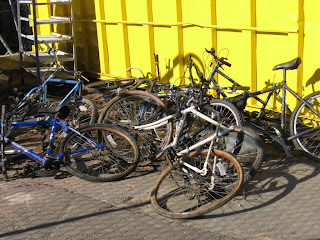
Bikes! Just lying there! In a pile next to the dumpster labeled "SCRAP METAL"! WTF!
Our best guess was that this is what Public Safety, in it's boundless wisdom, does with the bikes parked illegally throughout campus. If not, they are probably ( or also) bikes that were left behind by students who moved off campus/ graduated. Aside from the obvious indignation at the waste of perfectly useful bikes per se, this is TERRIBLE environmentally! Bikes take a lot of energy to break down. They do make good scrap metal BUT it's preferable that the bikes be put back into circulation because its a double-environmental benefit if people choose to bike instead of drive...SO we shouldn't throw them out until they're completely unsalvageable. These bikes are completely salvageable.
I propose two things for those of you who still attend AU:
1. lobby Public Safety (or whoever is throwing the bikes out) to do something more constructive with them, like maybe donate them somewhere or auction them back to students?
2. Get yourselves a free bike! It was wide open for the taking on Saturday, as you can see, although that might just be because that's the day the trash is collected. PEOPLE WHO PARKED THEIR BIKES ILLEGALLY: Reclaim them! PEOPLE WHOSE BIKES HAVE BEEN STOLEN: Get your free replacement! BIKE THIEVES: Steal 'em from the dump instead of being a jerk and stealing from a fellow poor student!
This Saturday I was playing basketball near the tennis courts with some fellow AU alums, and on my way back to my car-- in the space between the back of Bender and the track, near that parking lot for the service vehicles--
I noticed this:


Bikes! Just lying there! In a pile next to the dumpster labeled "SCRAP METAL"! WTF!
Our best guess was that this is what Public Safety, in it's boundless wisdom, does with the bikes parked illegally throughout campus. If not, they are probably ( or also) bikes that were left behind by students who moved off campus/ graduated. Aside from the obvious indignation at the waste of perfectly useful bikes per se, this is TERRIBLE environmentally! Bikes take a lot of energy to break down. They do make good scrap metal BUT it's preferable that the bikes be put back into circulation because its a double-environmental benefit if people choose to bike instead of drive...SO we shouldn't throw them out until they're completely unsalvageable. These bikes are completely salvageable.
I propose two things for those of you who still attend AU:
1. lobby Public Safety (or whoever is throwing the bikes out) to do something more constructive with them, like maybe donate them somewhere or auction them back to students?
2. Get yourselves a free bike! It was wide open for the taking on Saturday, as you can see, although that might just be because that's the day the trash is collected. PEOPLE WHO PARKED THEIR BIKES ILLEGALLY: Reclaim them! PEOPLE WHOSE BIKES HAVE BEEN STOLEN: Get your free replacement! BIKE THIEVES: Steal 'em from the dump instead of being a jerk and stealing from a fellow poor student!
Monday, February 4, 2008
Let's Save Our Planet!
So the Planet is in Peril. But a great crisis also presents a great opportunity. Being environmentally conscious is SO easy. For one day I ask you to do this. Everything you do....EVERYTHING during the course of the day, ask yourself if there is any way that that action could have an impact on the environment. If so...how? And then ask yourself how it could be fixed. We must all make individual sacrifices, but this crisis is serious and the danger becomes more apparent every single day. The scientific consensus is that global warming is happening, humans are to blame, and only we have the power to turn it around. Scientists also agree we have a very short time span to make radical changes.
So make individual sacrifices:
1. Buy the CFL energy-saver light bulbs. Save yourself LOTS of money in the long run AND save the environment.
2. Drive less. Walk more. Take Public Transportation. If you have to drive, car pool.
3. NEVER, and I mean NEVER get plastic bags at a grocery store. Plastic bags are awful for the environment and even if you recycle them it still emits way too much carbon to recycle plastic. They are already outlawed or virtually outlawed in two major US cities. BRING YOUR OWN BAGS! And if your forget, worst case scenario...ask for paper...they are much easier to recycle.
4. Recycle at home, at work, and get others to do the same.
5. Turn down your thermostat. 70 degrees is plenty warm enough, at the most.
There are a ton more.
Ultimately people can make a difference, but COMPANIES do the lion share of polluting. So we must take action. Big companies changing small policies can make a HUGE difference for the environment. What I have been noticing (since I started paying more attention) is how many companies have outrageous environmental policies and are incredibly wasteful. Every time I think of an outrage, I will post it here, and suggest action. I hope you will take action. I also hope you will post your own outrages. Write about what you saw, the problem, and propose a solution. Email it to scottforamerica@gmail.com, and I will put it on the blog. Good Journey!
So make individual sacrifices:
1. Buy the CFL energy-saver light bulbs. Save yourself LOTS of money in the long run AND save the environment.
2. Drive less. Walk more. Take Public Transportation. If you have to drive, car pool.
3. NEVER, and I mean NEVER get plastic bags at a grocery store. Plastic bags are awful for the environment and even if you recycle them it still emits way too much carbon to recycle plastic. They are already outlawed or virtually outlawed in two major US cities. BRING YOUR OWN BAGS! And if your forget, worst case scenario...ask for paper...they are much easier to recycle.
4. Recycle at home, at work, and get others to do the same.
5. Turn down your thermostat. 70 degrees is plenty warm enough, at the most.
There are a ton more.
Ultimately people can make a difference, but COMPANIES do the lion share of polluting. So we must take action. Big companies changing small policies can make a HUGE difference for the environment. What I have been noticing (since I started paying more attention) is how many companies have outrageous environmental policies and are incredibly wasteful. Every time I think of an outrage, I will post it here, and suggest action. I hope you will take action. I also hope you will post your own outrages. Write about what you saw, the problem, and propose a solution. Email it to scottforamerica@gmail.com, and I will put it on the blog. Good Journey!
Subscribe to:
Posts (Atom)